
Estepona Pueblo Property Prices in 2026: Notarial EUR/m2 in the Whitewashed Old Town
Registered notarial sale prices for Estepona Pueblo in 2026, with an adjacent-zone comparison table and the town-versus-coast price drivers.
In Estepona Pueblo, the consolidated town centre of the municipality, the registered sale price, what buyers actually paid at the notary, averaged 3,160 EUR/m2 across all property types in June 2026, with apartments at 3,166 EUR/m2, all villas at 3,128 EUR/m2 and resale villas at 3,113 EUR/m2 (listyco notarial data, 2026-06, Consejo General del Notariado). New-build villa data is not available for this zone this month, so the villa figures reflect the resale stock that defines a historic centre with little room for new detached construction.
What did property actually sell for in Estepona Pueblo in 2026?
Registered notarial sales in the zone averaged 3,160 EUR/m2 across all property types in June 2026: 3,166 EUR/m2 for apartments, 3,128 EUR/m2 for all villas and 3,113 EUR/m2 for resale villas, with new-build villas reporting n/a (listyco notarial data, Consejo General del Notariado). These are the prices recorded at the notary when a deed is signed.
| Property type | Registered price (EUR/m2), Estepona Pueblo, June 2026 |
|---|---|
| All property types | 3,160 |
| Apartments | 3,166 |
| All villas | 3,128 |
| Resale villas | 3,113 |
| New-build villas | n/a |
Source: listyco notarial data, 2026-06 (Consejo General del Notariado). The spread between apartments and villas is only 38 EUR/m2, an unusually tight band for the Costa del Sol, where villa figures typically run well above apartment figures in beachfront and golf zones. Here the two sit almost level because the central stock is dominated by apartments and townhouse-scale villas on tight plots rather than the large detached villas that pull villa averages up elsewhere.
How does Estepona Pueblo compare to its neighbouring zones?
Against the adjacent zones on the same notarial measure, Estepona Pueblo’s 3,160 EUR/m2 all-type average sits at the upper-middle of the local set (listyco notarial data, 2026-06, Consejo General del Notariado). It runs roughly 3 per cent above Estepona Centre, roughly 15 per cent above Estepona Golf, and roughly 20 per cent above Cancelada on the all-types line, while sitting roughly 12 per cent below La Cala de Mijas to the east and roughly 26 per cent below Casasola on the same measure.
| Zone (all types, EUR/m2) | All types | Apartments | Resale villas | All-villa gap vs Pueblo |
|---|---|---|---|---|
| Estepona Pueblo (baseline) | 3,160 | 3,166 | 3,113 | 0% |
| Estepona Centre | 3,073 | 3,054 | 3,080 | -1% |
| Estepona Golf | 2,693 | 2,505 | 2,662 | +7% |
| Cancelada | 2,529 | 2,545 | 2,438 | -22% |
| La Cala de Mijas | 3,528 | 3,419 | 4,529 | +37% |
| Casasola | 3,981 | 3,642 | 4,260 | +38% |
Source: listyco notarial data, 2026-06 (Consejo General del Notariado). All figures are registered notarial closing prices from the same cache month, so the comparison is like-for-like rather than a mix of asking-price headlines and closing data.
The sub-segment read matters here. On the apartment line, Estepona Pueblo (3,166 EUR/m2) sits above Estepona Centre, Estepona Golf, Cancelada, La Cala de Mijas and Casasola, so the town centre is the second-most expensive of this set for apartment buyers after Casasola. On the resale-villa line, the picture inverts: La Cala de Mijas and Casasola both register well above Estepona Pueblo, by roughly 45 and 37 per cent respectively, because both carry larger detached-villa stock on bigger plots. A buyer weighing a central apartment in Estepona Pueblo against one in the neighbouring coastal or inland zones pays a town-centre premium of roughly 15 per cent over Estepona Golf and roughly 24 per cent over Cancelada, while a buyer weighing a villa sees the opposite direction, with La Cala de Mijas and Casasola’s villa stock commanding roughly 45 and 37 per cent premia over the Pueblo resale-villa figure respectively. The all-types average hides this split: the apartment line carries the town-centre premium, the villa line does not.
What kind of place is Estepona Pueblo and who buys there?
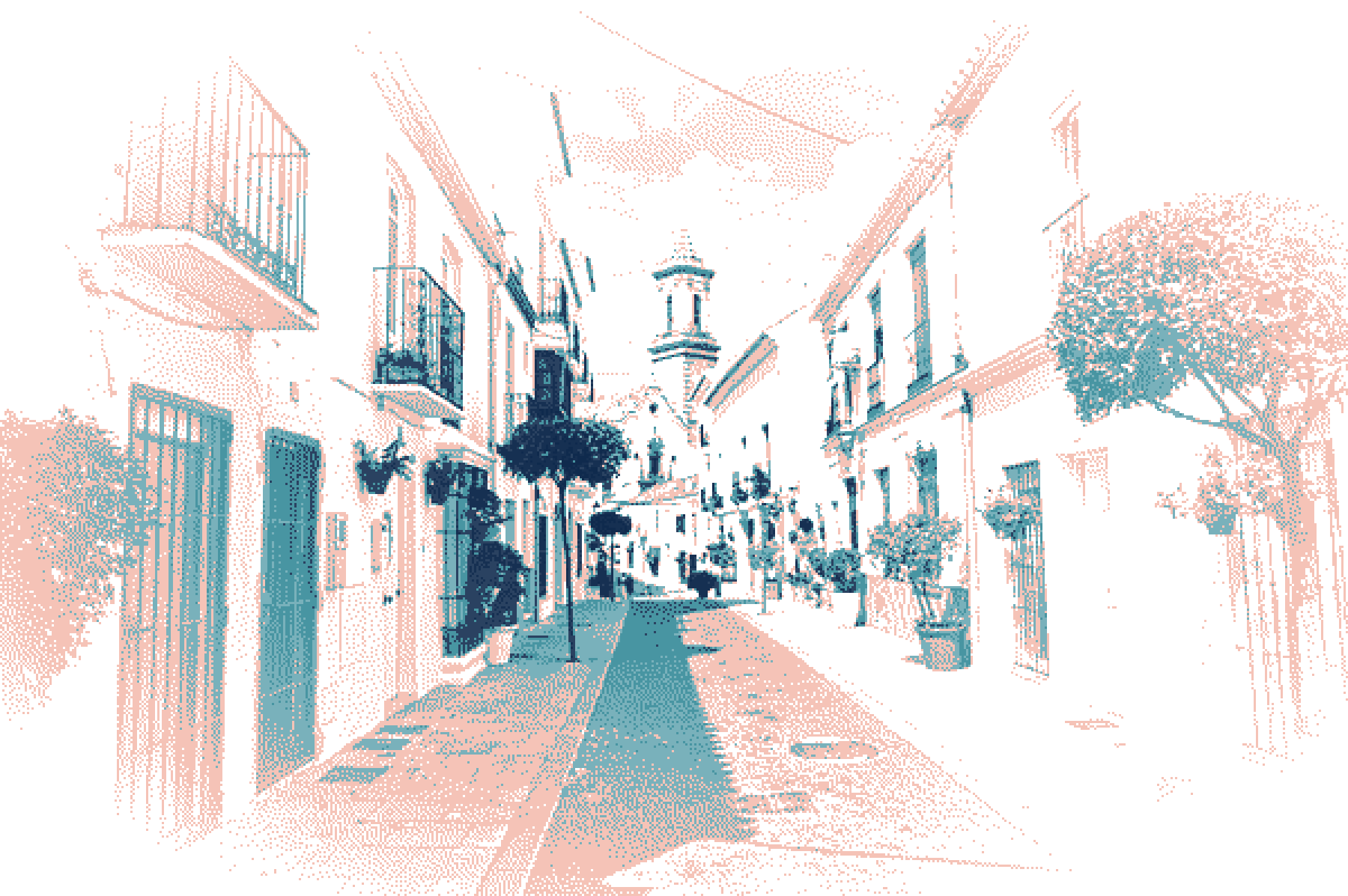
Estepona Pueblo is the historic town centre of the municipality, a pedestrianised grid of whitewashed streets and flower-filled plazas that has been reshaped over the past decade and a half under the municipal “Jardín de la Costa del Sol” renewal programme. The town hall, under mayor José María García Urbano, has redesigned nearly 100 streets in the casco histórico to resurface paving, add planted flower pots and recover the Andalusian architectural character that earlier decades of unchecked development had eroded. The flagship public spaces, Plaza de las Flores and the Plaza del Reloj, sit within walking distance of the beachfront Paseo Marítimo, and the old town’s commercial spine runs along Calle Real and Calle Terraza.
The cultural anchor of the renewal is the Ruta de Murales Artísticos, a municipal mural project launched in 2012 that has grown to almost 50 large-format works on building facades across the centre and near-centre districts, including “Día de Pesca”, cited as the largest vertical mural in Spain by surface area, and “Reflejos del jardín”, cited as the largest vertical mural in Europe by a single artist, both by the realist painter José Fernández Ríos (Ayuntamiento de Estepona). A complementary Ruta de Poesía installs verses on building walls and a Ruta de Esculturas places sculptures along the seafront. Together these projects were designed to de-seasonalise tourism and give the centre year-round draw, which they have done: the old town now sustains restaurants and bars through the winter months in a way the beachfront alone never could.
The buyer profile here is distinct from the beachfront-corridor or golf-zone buyer. Estepona Pueblo attracts relocators who want a walkable, full-year urban life with schools, medical centres, municipal markets and tapas bars on the doorstep, rather than a gated villa in a resort urbanisation. The municipality’s population stood at 79,593 on the 2025 padrón register (INE), up from 71,696 at the 2021 census, a growth trajectory driven largely by northern European relocators settling in and around the town centre. Spanish families from Madrid and the interior also buy here, drawn by the historic-centre character that the renewal recovered. The zone is not a holiday-let hotspot in the mould of the New Golden Mile; it is a place where buyers live, which is why the registered transaction mix skews toward apartments and townhouses rather than short-let villas. For the wider Estepona context, including how the town centre relates to the beachfront corridor, see the Estepona area guide.
What drives prices in Estepona Pueblo?
Three factors shape the EUR/m2 figure here: the town-versus-coastal-strip position, the consolidated urban fabric that caps new supply, and the town-centre premium that the municipal renewal has built.
Town versus coastal strip. The defining price driver is the trade-off between the walkable old town and the frontline-beach coastal corridor that runs east toward San Pedro. Estepona Pueblo carries a different value proposition from the beachfront zones: it forgoes the seafront position in exchange for year-round urban amenity, schools, medical centres and the pedestrianised cultural spine. The result is a registered all-type figure that sits above the golf-side and corridor zones within the same municipality on the same notarial measure (roughly 15 per cent above Estepona Golf and roughly 20 per cent above Cancelada), because buyers pay for the amenity, but below the larger-plot detached-villa zones to the east (roughly 12 per cent below La Cala de Mijas) where the villa stock itself drives the all-type figure up. The town-versus-coast distinction is the single most important frame for reading the Pueblo numbers: a buyer is choosing urban amenity over beachfront position, not paying less for the same thing.
Consolidated stock, no new land. The defining constraint on Estepona Pueblo is that it is a built-out historic grid. There is no vacant land for new detached villas, which is why the new-build villa figure reports n/a this month. The supply that trades is resale: apartments in restored buildings, townhouses on the narrow streets behind Calle Real, and the occasional detached villa on the larger plots near the edge of the casco. This cap on new supply means the registered average moves on demand for the existing stock rather than on the injection of turnkey new product that drives figures in the inland golf urbanisations, where new-build villas register a premium of roughly 35 per cent over resale villas on the same notarial measure.
The renewal premium. The “Jardín de la Costa del Sol” programme is not cosmetic. The redesigned streets, the mural route and the poetry route have turned the casco histórico into a destination in its own right, which supports demand for central residential property from buyers who want the amenity without needing a car. A 2026 townhouse development on Calle Caridad, two streets back from the beach and within walking distance of the tapas bars and shops around Plaza de las Flores, signals that developers see enough demand to build new product inside the historic grid, on the rare plots where older stock is cleared (Olive Press, May 2026). That kind of infill is the only new supply the zone will see.
How does the wider Spanish market affect Estepona Pueblo in 2026?
The wider market backdrop is the strongest price appreciation in nearly two decades. Tinsa’s IMIE Mercados Locales for the second quarter of 2026 put the annual rise in finished housing at 15.2 per cent, with a 3.7 per cent quarterly advance, the highest reading since the third quarter of 2006 and 11.8 points above general inflation (Tinsa, IMIE Mercados Locales, Q2 2026). The INE Housing Price Index reported a 12.9 per cent annual rate nationally for Q1 2026, with new homes up 9.1 per cent and second-hand homes up 13.5 per cent (INE, HPI, Q1 2026). The two indices measure different things, Tinsa tracks valuation trends in finished housing while INE tracks actual transaction prices, but both confirm a market in double-digit annual appreciation.
For local context, Tinsa’s Q2 2026 Marbella city figure sits at 3,694 EUR/m2, up 18.31 per cent year-on-year, against a national annual rate of 15.5 per cent and an Andalusian rate of 10.6 per cent (Tinsa, IMIE Mercados Locales, Q2 2026). Estepona Pueblo’s registered 3,160 EUR/m2 runs roughly 14 per cent below the Marbella city Tinsa benchmark, the expected directional relationship for a more accessible but firmly established market on the western Costa del Sol, the same pattern as the other value-town-centre zones and the opposite of the premium-above pattern in the Benahavís hillside estates and the Golden Mile. The town centre trades at a discount to the Marbella city benchmark not because the old town is soft but because its stock mix is apartment- and townhouse-heavy rather than villa-heavy, and the apartment figure (3,166 EUR/m2) is the closer comparable to the Marbella city Tinsa average than the all-type blended figure. For the full acquisition-cost breakdown, including the 7% Andalusian ITP on resales and 10% IVA on new-build, see the cost of buying guide.
Why are registered prices the figure a buyer should use?
Registered notarial prices are lower than asking prices because they record every signed transaction across the full mix of resales, older stock and transfers, rather than the prime, newly listed properties that set the portal headlines. They are the floor of reality: what comparable homes actually closed at. A buyer who anchors a negotiation to the 3,160 EUR/m2 registered average, then adjusts up for a beachfront street, a renovated building, or a balcony over a pedestrianised plaza, is working from what the market did rather than what it hopes to do.
The tight apartment-villa spread here is itself a negotiation signal. In a zone where villas and apartments close within 38 EUR/m2 of each other, a seller asking a large villa premium over the apartment figure needs to justify it with something specific, a larger plot, a sea view, a renovated interior, because the registered data does not support a wide structural gap between the two categories in this stock mix. For the rental yield picture, Estepona Pueblo’s position as a year-round residential centre rather than a seasonal beach-rental zone means rental demand skews toward long-term tenants, which produces a different yield profile from the peak-summer holiday-let zones along the corridor.
How should a buyer read these numbers?
Use the registered notarial figure as your benchmark for what the central stock actually trades at, then adjust for the specific position and condition of the property you are evaluating. The n/a on new-build villas tells you that this zone is a resale market, which is the structural reality of a consolidated town centre and not a data gap. If you are evaluating a renovated apartment on a pedestrianised street near Plaza de las Flores, the 3,166 EUR/m2 apartment figure is your direct comparable. If you are evaluating a townhouse or small detached villa on the edge of the casco, the 3,128 EUR/m2 all-villa figure and the 3,113 EUR/m2 resale-villa figure are your anchors.
The municipal renewal is the story that supports the price level. A town centre that has invested in its public realm, its cultural routes and its pedestrian environment over more than a decade is a different proposition from one that has not, and the registered figures here reflect buyers paying for that amenity. The cost of buying guide sets out the 7% ITP that applies to these resale transactions across Andalusia, which is the tax a buyer adds on top of the notarial price.
Frequently asked questions
- What is the average price per m2 in Estepona Pueblo in 2026?
- Registered notarial sales averaged 3,160 EUR/m2 across all property types in June 2026, with apartments at 3,166 EUR/m2, all villas at 3,128 EUR/m2 and resale villas at 3,113 EUR/m2 (listyco notarial data, Consejo General del Notariado). That is what actually closed at the notary, not an asking price.
- Why is there no new-build villa figure for Estepona Pueblo?
- The cache reports n/a for new-build villas in this zone. Most Costa del Sol town-centre zones have too few registered new-build villa transactions to produce a reliable figure, because the consolidated urban fabric leaves little room for new detached construction. The villa figure here reflects resale stock only.
- Why are apartments and villas priced so close together in Estepona Pueblo?
- The 38 EUR/m2 spread between apartments (3,166) and all villas (3,128) is unusually tight for the Costa del Sol. It reflects a central stock mix where the villa category is dominated by townhouses and smaller detached homes on tight town-centre plots rather than the large beachfront or golf-front villas that push villa prices far above apartments in marina and golf zones.
- How does Estepona Pueblo compare to the New Golden Mile?
- Estepona Pueblo is the consolidated town centre, a pedestrianised historic grid of whitewashed streets, while the New Golden Mile is the beachfront corridor running east toward San Pedro. The town centre trades frontline-beach position for walkable urban amenity, and its registered figures reflect central apartments and townhouses rather than the beachfront villas and resort apartments that define the corridor.
- Are registered notarial prices lower than the asking prices I see online?
- Yes. Asking prices are what sellers list. Registered notarial prices are what buyers and sellers actually signed for at the notary, across the full mix of resales and transfers. The registered average is the more reliable signal of what changed hands and is the figure a buyer should anchor a negotiation to.
Sources and data
- Centro de Informacion Estadistica del Notariado (notarial transaction statistics) — Consejo General del Notariado
- Precio vivienda en la ciudad de Marbella (IMIE Mercados Locales Q2 2026) — Tinsa
- IMIE Mercados Locales 2º trimestre 2026: + 15,2 % — Tinsa
- Indice de Precios de Vivienda (IPV), Comunidades Autonomas — INE
- Estepona crea el primer mural braille de Espana y se situa a la vanguardia del arte urbano (Ruta de Murales) — Ayuntamiento de Estepona
- Poblacion por municipios, sexo y edad (Padron municipal, Estepona) — INE